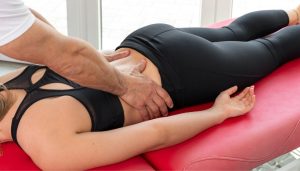
Upper cervical headache refers to headache originating from the three uppermost segments of the cervical spine: C1, the atlas; C2, the axis; and C3, the third cervical vertebra. These three segments are anatomically unique in the spine because their nerve roots converge with the trigeminal nerve in the trigeminal nucleus caudalis of the lower brainstem, a convergence that allows dysfunction at these cervical levels to be perceived as pain in the head rather than pain in the neck.
Upper cervical headache is not a single diagnosis. It is a mechanism. It underlies cervicogenic headache in its formal sense, and it contributes as a peripheral driver to many presentations of migraine, chronic migraine, and tension-type headache where the cervical component has not been identified. The Watson Headache Approach, available at MyoFitness across Melbourne at Yarraville, North Melbourne, and Surrey Hills, is the clinical protocol developed specifically to assess and treat upper cervical headache by directly targeting the dysfunctional segments at C1, C2, and C3.
The upper cervical spine is uniquely capable of producing head pain because of a specific anatomical arrangement found nowhere else in the spinal column. C1, C2, and C3 connect directly to the brainstem pain-processing structure responsible for all head and face pain. Dysfunction at any of these levels is literally within reach of the trigeminal system.
To understand cervicogenic headache, you need to understand a specific anatomical arrangement that is unique to the uppermost region of the cervical spine.
The three uppermost cervical nerve roots, C1, C2, and C3, project centrally into the trigeminal nucleus caudalis: a pain-processing structure in the lower brainstem that also receives the descending fibres of the trigeminal nerve. The trigeminal nerve is the primary sensory nerve of the head and face, supplying the scalp, forehead, temples, periorbital region, face, jaw, and meninges.
Because C1, C2, and C3 afferents converge with trigeminal afferents in the same brainstem nucleus, the brain cannot reliably distinguish between a pain signal that originated at C2 and one that originated in the trigeminal territory of the head. Both are processed through the same structure and both are perceived as head pain. This anatomical convergence is the trigeminocervical complex, and it is the neurophysiological foundation of cervicogenic headache.
When a structure supplied by C1, C2, or C3 becomes dysfunctional, the afferent signals it generates feed into the trigeminocervical complex and are perceived as pain in the head. The neck may feel stiff. Or it may feel entirely normal to the person experiencing it. But the pain appears in the head, and without specific assessment of the upper cervical spine, nothing clinically connects the two.
Our practitioner attended the Watson Headache Institute Level 1 Foundation Headache Course titled “Cervicogenic Headache and The Role of C1-C3 Cervical Afferents in Primary Headache” presented by Dr Dean H Watson PhD, Australian Musculoskeletal Physiotherapist. For further information, go to: www.WatsonHeadacheApproach.com
The course was based on the Watson Headache Approach, a protocol for the skilled assessment and management of the upper cervical (neck) spine in Cervicogenic and Primary Headache, and related conditions in which the underlying dysfunction is sensitisation of the lower brainstem. The Watson Headache Approach is recognised as a scientifically researched method of examination as well as a comprehensive clinical management system. For further information, go to: www.WatsonHeadacheApproach.com
If you are in Melbourne’s inner west and your headaches have not responded to medication or general treatment, the upper cervical spine may not have been assessed. The Watson Headache® Approach at MyoFitness Yarraville does exactly that.
The Watson Headache Approach is the most specific manual therapy intervention for the cervical component of migraine. It is not the only way that physiotherapy and myotherapy contribute to migraine management. Several other clinical approaches are used at MyoFitness to support migraine patients, often in combination with upper cervical treatment.
The range of headache types that upper cervical dysfunction produces
The formal diagnostic category for headache caused by cervical spine dysfunction. C1, C2, or C3 dysfunction is the most common identified source. Presents as unilateral head pain that typically begins at the base of the skull and radiates forward, frequently accompanied by ipsilateral neck stiffness and restricted cervical range of motion.
Upper cervical joint dysfunction produces pericranial muscular tension and bilateral pressing head pain that precisely fits the description of tension-type headache. In many cases, the upper cervical afferent input is the primary driver of both the headache and the muscular tension that accompanies it.
Headache that persists after concussion commonly has a significant upper cervical component from cervical injury occurring at the time of the concussive event. The cervical injury may be clinically overlooked because the concussion itself dominates the clinical picture, but the headache that persists is often substantially cervicogenic in origin.
Many people with a migraine diagnosis have an unidentified upper cervical component that is sustaining brainstem sensitisation and amplifying attack frequency. The migraine may be genuine, but the upper cervical dysfunction is lowering the threshold and maintaining the sensitised state through which attacks are generated more easily.
Irritation or sensitisation of the greater occipital nerve, which arises from C2, produces sharp, electric, or throbbing pain in the posterior scalp. Because the C2 segment is the anatomical source, Watson Headache assessment and treatment of C2 is the clinically appropriate approach to occipital neuralgia where a cervical origin is confirmed.
Whiplash injury produces shear and compressive forces through the C2-C3 facet joint that are among the most commonly identified structural sources of upper cervical headache at MyoFitness. Post-whiplash headache that begins or persists after cervical injury, even months or years later, has a high likelihood of having a C2-C3 component amenable to Watson Headache treatment.
The MyoFitness Yarraville clinic at 231 Hyde Street is accessible from across the inner west. All of the following suburbs are within easy reach of the clinic.
MyoFitness also operates clinics in North Melbourne at 154 Peel Street and Surrey Hills at 296A Canterbury Road. All three clinics offer Watson Headache® Approach assessment and treatment for migraine.
Three well-established clinics across North Melbourne, Yarraville, and Surrey Hills, each delivering the same standard of clinical care.
A clinical team spanning remedial massage, myotherapy, physiotherapy, lymphatic drainage, and psychology under one roof.
Recognised for clinical outcomes, patient experience, and professional standards across the allied health industry.
Every session begins with a clinical assessment. Treatment is directed at the actual cause of your pain, not just the location where you feel it.
Not every migraine pattern has a significant musculoskeletal component. The presentations most likely to benefit from physiotherapy and myotherapy at MyoFitness share some identifiable clinical features.