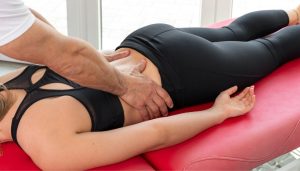
A headache at the base of the skull that radiates up the back of the head, over the top, and sometimes even behind the eye. It may have begun after a car accident or a fall, or it may have crept up slowly over months of poor posture and desk work. It worsens when you look up, worsens when you turn your head, and settles a bit when you rest. You may have already seen a GP or a neurologist, and they have ruled out migraine, tension, and the usual suspects. What you are left with is a puzzle: a headache that is clearly connected to your neck, but that regular massage and stretching have not touched.
This is where the Watson Headache® Approach makes its entry. It is not a treatment for all headaches, but it is a precise, researched protocol for one specific thing: headaches driven by dysfunction of the upper cervical spine, the C1, C2, and C3 segments at the very base of the skull. Unlike a general massage, which releases tension everywhere, the Watson method is a diagnostic tool first and a treatment second. It finds the exact segment of the neck that is driving your headache, reproduces the headache to confirm it, and then uses specific, gentle techniques to restore normal function to that segment. For people with cervicogenic headache or occipital neuralgia, it is genuinely different, and it works.
A headache at the base of the skull is almost never just tension. The upper cervical spine is wired directly to the head, and when those segments move wrong or get stuck, they send pain signals all the way up to the top of the skull, behind the eye, and into the temple. Finding which segment is the problem, rather than treating the whole neck, is what transforms the outcome.
The upper cervical spine, the three vertebrae at the base of your skull called C1, C2, and C3, has an unusual relationship with the head. These segments are wired to the trigeminal nerve, the largest sensory nerve in the head. When a C1, C2, or C3 segment moves abnormally, gets stiff, or becomes irritated, that irritation is directly relayed to the trigeminal system, which interprets it as head pain. This mechanism is called the trigeminocervical complex, and it is the reason that a stiff or misaligned neck segment can feel exactly like a headache.
That headache will typically be one-sided, worse when the neck moves or sustains an awkward position, and often located at the base of the skull, radiating upward into the back of the head, over the crown, and sometimes forward to behind the eye or temple. It is not a migraine (which usually has a pulsing quality and nausea), not tension-type (which is bilateral and diffuse), and not a cluster headache. It is cervicogenic: driven by the cervical spine. And because it is driven by a biomechanical problem, it is one of the most treatable headaches there is.
Three headache patterns from the neck: knowing which is yours
Upper neck dysfunction can show up as three distinct patterns. Understanding which one applies to you is the first clue to the right treatment.
Pattern 1
Cervicogenic
Postural, movement-triggered
A dull, tightening, one-sided headache at the base of skull, worse with neck movement or sustained posture such as looking up or working at a computer. Tender over the upper cervical segments. Eased by rest and gentle neck movement in the opposite direction. Caused by joint dysfunction, muscle tightness, or stiffness in C1–C3.
Pattern 2
Occipital Neuralgia
Sharp, nerve-based
Sharp, stabbing, shock-like pain in the distribution of the occipital nerves (the greater, lesser, or third occipital nerves). Pain comes in bursts lasting seconds to minutes, follows a specific nerve pathway, and can be triggered by touch over the nerve or certain neck movements. More neuropathic in character than mechanical.
Pattern 3
Referred Pain
Behind the eye & temple
Pain originating from the upper neck but felt behind the eye, in the temple, or across the forehead. Happens because of the way the trigeminal nerve receives input from C1–C3. Often worst on one side. Worse with neck movement or strain. Responds to upper cervical treatment even though the pain is felt distant from the source.
One of the defining features of a cervicogenic headache is that it gets worse with specific neck movements or postures. This is the mechanical signature of the condition, and it is what distinguishes it from migraine or other primary headache disorders. Looking up, turning the head to one side, holding the head forward (as in desk work), or sustaining any position that strains the upper cervical spine will trigger or aggravate the pain. Conversely, movements that ease tension in the neck, or simply resting, tend to settle it.
This happens because the upper cervical segments control a huge amount of proprioceptive (position-sensing) traffic back to the brainstem and trigeminal system. When those segments move abnormally or get stuck, that proprioceptive signal is distorted, and the trigeminal system interprets it as pain. The stiffer or more misaligned the segment, the worse the signal. A segment that is locked in a forward-head posture will send constant irritation signals. A segment that has lost one direction of movement, such as rotation to the right, will fire up pain when the head is turned that way. This is not permanent damage. It is mechanical dysfunction, and it is reversible.
If your headache worsens with neck movement or sustained posture, your neck is the source. The Watson Headache® Approach finds the exact segment and restores it. Book an assessment at MyoFitness. No referral required.
If your headache worsens with neck movement or sustained posture, your neck is the source. The Watson Headache® Approach finds the exact segment and restores it. Book an assessment at MyoFitness. No referral required.
This is the crucial distinction, and it is worth spelling out clearly because many people have had neck massage or general physiotherapy and found it did not touch their headache. Here is why, and how Watson is different.
Treats muscles broadly. Releases tension across the whole neck, shoulders and upper back. Improves general circulation. Feels good and provides temporary relief. But does not identify or address the specific joint segment causing the headache.
Isolates and diagnoses the faulty segment. Uses a specific protocol of gentle pressures applied to C1, C2, and C3 individually. Reproduces your typical headache to confirm which segment is at fault. Then uses precise techniques to restore function to that segment alone.
Temporary reproduction of your typical headache during examination is diagnostic. As the specific technique is sustained and applied correctly, the reproduced pain lessens and resolves within 30–90 seconds. This tells the practitioner the segment is responding and is indeed the source.
Treatment targets the root cause, not just the symptom. Once the faulty segment is restored to normal movement and position, the headache does not simply ease temporarily. It stays better, because the biomechanical problem has been resolved.
Most neck headaches don’t show clearly on MRI or X-ray. While imaging is valuable for ruling out serious pathology, the small movement dysfunctions occurring at C1, C2, and C3 are functional rather than structural. The joints may appear normal on a scan while still producing significant headache through abnormal movement and irritation of the upper cervical nerves.
The goal is lasting improvement, not temporary symptom control. Once the dysfunctional upper cervical joint has been restored to normal movement, treatment gradually shifts toward maintaining that improvement. Education, posture advice, ergonomic changes, and simple home exercises help reduce repeated loading on the upper neck and minimise recurrence.
The MyoFitness Yarraville clinic at 231 Hyde Street is accessible from across the inner west. All of the following suburbs are within easy reach of the clinic.
MyoFitness also operates clinics in North Melbourne at 154 Peel Street and Surrey Hills at 296A Canterbury Road. All three clinics offer Watson Headache® Approach assessment and treatment for migraine.
Three well-established clinics across North Melbourne, Yarraville, and Surrey Hills, each delivering the same standard of clinical care.
A clinical team spanning remedial massage, myotherapy, physiotherapy, lymphatic drainage, and psychology under one roof.
Recognised for clinical outcomes, patient experience, and professional standards across the allied health industry.
Every session begins with a clinical assessment. Treatment is directed at the actual cause of your pain, not just the location where you feel it.
Both of these conditions cause pain at the base of the skull and both respond to hands-on treatment, but they are different enough that the treatment emphasis shifts. It is worth knowing which one you have, because it changes what to expect.