Vestibular migraine is one of the most frequently misdiagnosed neurological conditions seen in clinical practice. The characteristic feature that makes it so difficult to identify is that in many episodes, the headache is mild, absent, or overshadowed by the vestibular symptoms: dizziness, vertigo, a sense of motion when there is none, spatial disorientation, and difficulty maintaining balance. People with vestibular migraine are often told they have benign paroxysmal positional vertigo, Meniere’s disease, inner ear problems, anxiety, or functional dizziness before the migraine diagnosis is established.
Vestibular migraine is now recognised as the most common cause of spontaneous episodic vertigo in adults, occurring in approximately 1 percent of the population and significantly more commonly in women. Its clinical management typically centres on identifying and avoiding triggers, pharmacological prophylaxis, and vestibular rehabilitation. What is less commonly explored is the role of the upper cervical spine in maintaining the brainstem sensitisation that makes vestibular migraine attacks more frequent and more severe.
The Watson Headache Approach, available at MyoFitness across Melbourne at Yarraville, North Melbourne, and Surrey Hills, provides a specific clinical assessment of the upper cervical spine’s contribution to headache and migraine, including vestibular migraine where C1, C2, or C3 dysfunction is sustaining the sensitised brainstem state through which vestibular symptoms are generated.
Vestibular migraine is defined by the International Headache Society and the Barany Society as recurrent vestibular episodes of moderate or severe intensity lasting 5 minutes to 72 hours, occurring in a person with a current or past history of migraine, with migrainous features present during at least half of the vestibular episodes. Migrainous features during episodes include headache with at least two migraine characteristics, photophobia, phonophobia, or visual aura.
The vestibular symptoms in vestibular migraine can include spontaneous vertigo, positional vertigo, visually induced vertigo, head motion-induced vertigo, and head motion-induced dizziness with nausea. Importantly, significant headache does not need to be present during every episode for the diagnosis to apply. This is why vestibular migraine is so frequently unidentified: the presenting complaint is dizziness or vertigo, not headache, and the migraine history is not connected to the vestibular episodes without a comprehensive clinical history.
The anatomical basis for the upper cervical spine’s contribution to vestibular migraine is specific and well-established in neuroanatomy. The vestibular nuclei, which receive and integrate signals from the inner ear, the cerebellum, the visual system, and the body’s proprioceptive system, are located in the dorsal brainstem in close anatomical proximity to the trigeminal nucleus caudalis.
The upper cervical proprioceptors, particularly those associated with the joints and muscles of C1 and C2, project directly to the vestibular nuclei. This connection is part of the cervico-ocular reflex system, which contributes to gaze stabilisation and spatial orientation during head movement. When dysfunction at C1 or C2 generates abnormal proprioceptive signals, these abnormal afferent inputs arrive at vestibular nuclei that are already sensitised through trigeminocervical complex activity.
The consequence is that upper cervical dysfunction does not only lower the threshold for headache in vestibular migraine. It simultaneously introduces abnormal proprioceptive input into a vestibular system that is operating in a sensitised brainstem environment. This convergence explains why dizziness, vertigo, and spatial disorientation are so prominent in vestibular migraine when upper cervical dysfunction is a contributing factor, and why Watson Headache assessment at MyoFitness is clinically relevant for this presentation.
What Watson Headache assessment looks for in vestibular migraine
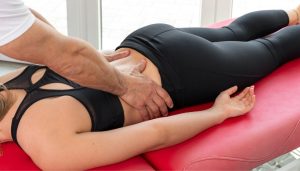
The Watson Headache assessment in vestibular migraine follows the same protocol as in other headache presentations: specific sustained manual pressure is applied to C1, C2, and C3 individually, and the clinical test is whether provocation reproduces familiar symptoms. In vestibular migraine, the reproduced symptoms may include the familiar sense of dizziness or spatial disorientation, prodromal headache symptoms, or neck pain and suboccipital heaviness that the person has come to associate with the onset of vestibular episodes.
Reproduction of vestibular symptoms during cervical provocation is a clinically significant finding. It indicates that the dysfunctional cervical segment is generating afferent input that is directly activating or sensitising the brainstem structures involved in vestibular processing, confirming that the cervical spine is a contributor to the vestibular migraine pattern rather than an incidental finding.
Our practitioner attended the Watson Headache Institute Level 1 Foundation Headache Course titled “Cervicogenic Headache and The Role of C1-C3 Cervical Afferents in Primary Headache” presented by Dr Dean H Watson PhD, Australian Musculoskeletal Physiotherapist. For further information, go to: www.WatsonHeadacheApproach.com
The course was based on the Watson Headache Approach, a protocol for the skilled assessment and management of the upper cervical (neck) spine in Cervicogenic and Primary Headache, and related conditions in which the underlying dysfunction is sensitisation of the lower brainstem. The Watson Headache Approach is recognised as a scientifically researched method of examination as well as a comprehensive clinical management system. For further information, go to: www.WatsonHeadacheApproach.com
If your dizziness or vertigo is associated with neck stiffness, worsens with neck movement, or occurs alongside headache, the upper cervical spine may be contributing to your vestibular migraine pattern. Watson Headache assessment at MyoFitness tests this directly. Three Melbourne clinics. No referral required.
Sustained, targeted pressure into deeper layers of fascia and musculature for clients with chronic tension that surface-level work cannot reach.
Advanced musculoskeletal therapy using trigger point therapy, myofascial release, dry needling, and corrective exercise to address root causes of pain.
Movement science applied to recovery: biomechanics assessment, rehabilitation exercise, and collaboration across the clinical team.
Pre-event preparation, post-event recovery, and ongoing maintenance to keep athletes performing at their peak and recovering faster.
Fine filiform needles targeting active trigger points to produce rapid muscle relaxation, reduce referred pain, and release endorphins.
Gentle MLD techniques to stimulate lymph flow, reduce tissue swelling, and support post-surgical recovery and immune function.
Sustained, targeted pressure into deeper layers of fascia and musculature for clients with chronic tension that surface-level work cannot reach.
The MyoFitness Yarraville clinic at 231 Hyde Street is accessible from across the inner west. All of the following suburbs are within easy reach of the clinic.
MyoFitness also operates clinics in North Melbourne at 154 Peel Street and Surrey Hills at 296A Canterbury Road. All three clinics offer Watson Headache® Approach assessment and treatment for migraine.
Three well-established clinics across North Melbourne, Yarraville, and Surrey Hills, each delivering the same standard of clinical care.
A clinical team spanning remedial massage, myotherapy, physiotherapy, lymphatic drainage, and psychology under one roof.
Recognised for clinical outcomes, patient experience, and professional standards across the allied health industry.
Every session begins with a clinical assessment. Treatment is directed at the actual cause of your pain, not just the location where you feel it.